Column · @landennzkg406
Peptide Testing: Hplc & Mass Specification Purity Overview Pinnacle
Recognizing Peptide Purity Testing
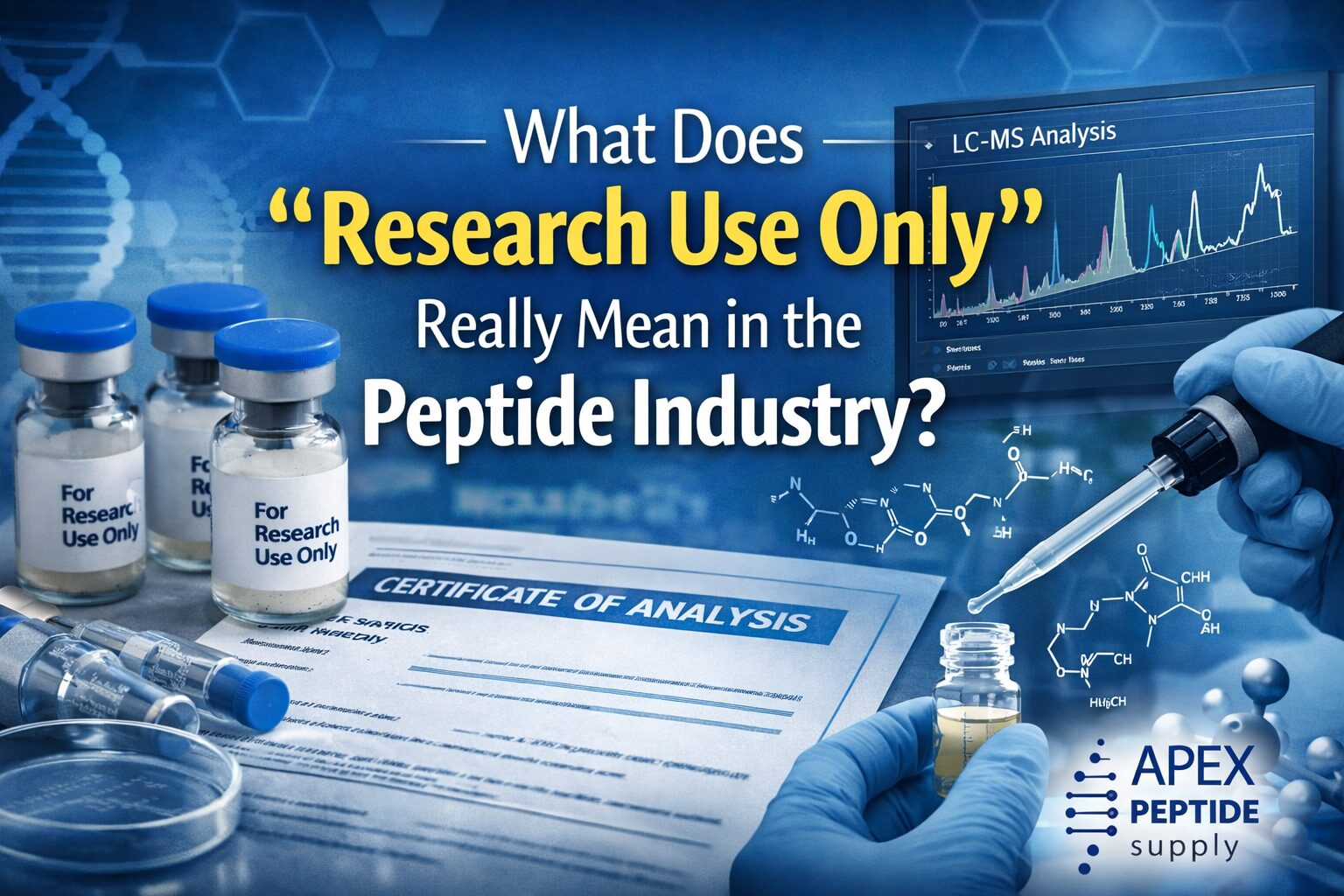
Theoretically, peptide pureness is evaluated by the chromatogram generated by reversed phase HPLC, and in addition, we can acquire the number and relative quantity of possible by-products by determining the peak area. A high-quality chromatogram has a single, in proportion main top with a level standard on either side. " Trailing"-- where the top trails off gradually on one side-- can suggest column troubles, sample overloading, or additional interactions between the peptide and the stationary phase. In this setup, the stationary stage is hydrophobic (water-repelling), typically C18-bonded silica. The mobile stage is a gradient of water and an organic solvent like acetonitrile, commonly with a percentage of trifluoroacetic acid (TFA) to develop the optimals." Mass spectrometry responses "is the identified substance regular with the designated peptide identity? " With each other they supply stronger batch-level evidence than either method alone. In the typical peptide COA context, top pureness normally refers to the percent of complete chromatogram location stood for by the primary peptide optimal.
A functional assay determining downstream signaling-- or an architectural research utilizing NMR or X-ray crystallography-- demands the highest possible purity offered. Crystallographers in particular frequently require ≥ 98% purity because also small pollutants can protect against crystal development or present disorder into the crystal lattice. As particles leave the column, they go through a detector-- normally a UV detector set to 214 or 220 nm, wavelengths where the peptide bond soaks up light highly. The detector records just how much UV light is taken in in time, creating a chart called a chromatogram. This guide breaks down what purity in fact suggests in peptide chemistry, just how it's gauged, what the impurities are, and how to check out the documentation that confirms a peptide is what it asserts to be.- Poor-quality peptides (those with undiscovered impurities, wrong sequences, or deteriorated components) can bring about misleading information and irreproducible results.
- A peptide's pureness portion informs you just how much of that sample is the genuine deal versus by-products, with typical research study grades being around 95% up to 98-99% for extra pureness.
- Basically, extensive lab validation is just how you prove to regulators that your peptide fulfills all quality specifications.
- Trusted peptide screening laboratories will offer a suite of contemporary analytical strategies-- HPLC paired with MS is a must, and availability of additional approaches like capillary electrophoresis or amino acid evaluation is a benefit.
- In practical COA evaluation, the term typically describes pureness screening, identity screening, and documents evaluation.
Innovative Peptides suggests a series of different pureness degrees to assist you select the appropriate peptide purity for peptide-based assays and applications. The adhering to checklist reveals the suggested peptide pureness levels needed for different peptide applications. Peptide recognition is mainly carried out utilizing mass spectrometry (MS), which gives exact dimensions of peptide molecular weight. In addition, techniques such as amino acid analysis and HPLC are used to confirm the peptide's identity and pureness, making sure precise characterization for numerous applications. We give peptide identity confirmation making use of mass-based techniques picked for the sample and analytical function. This is important when the primary question is whether the observed part matches the intended peptide or whether a modification has been included as anticipated.
What A Concerning Chromatogram Resembles
Notably, this pureness number is generally identified after purification (e.g. by HPLC) and concentrates on peptide impurities-- it doesn't count residual water, salts, or counter-ions in the dried peptide powder. Simply put, the pureness percentage is about the structure of peptide varieties in the example, not the weight contribution of water or salts. A peptide might be 98% pure https://aminoacidsupplements.co/ (indicating extremely few peptide pollutants) yet still have some water or trifluoroacetate salt; those non-peptide elements would certainly be mirrored in the net peptide material rather than the purity percent. At Creative Peptides, we give custom peptide chemical and physical analyses for research groups that require reliable information on peptide identity, pureness, structure, remedy behavior, and sample top quality. Our solution sustains synthetic, customized, cyclic, conjugated, and difficult peptide examples with analytical workflows constructed around the actual task inquiry as opposed to a fixed default panel.Thorough Peptide Top Quality Screening Services
BOC Sciences uses thorough peptide testing solutions to clients across sectors, making sure items satisfy strict market requirements and ensuring item consistency, safety, and efficiency. It also supports traceability-- each set's lab recognition record can be tied to its COA and regulative filings, producing a clear proof. In other words, extensive lab recognition is just how you show to regulators that your peptide fulfills all quality specifications. It helps prevent compliance issues such as fallen short audits or item remembers due to top quality problems. This not only pleases lawful demands yet eventually protects patient safety and security.The Optimals
A solitary generic chromatographic method is commonly insufficient for peptides that are hydrophobic, highly basic, closely related in turn, or partially cleansed. We give HPLC and UPLC purity evaluation workflows that focus on beneficial splitting up rather than just producing a portion. We create analytical process around the sample kind, sequence attributes, alteration profile, and decision context. Tasks may entail crude intermediates, purified peptides, kept lots, client-supplied materials, or products created with our customized peptide synthesis platform.BOC Sciences offers multi-batch comparison evaluation to help clients develop raw material quality standards and ensure uniformity. Recurring non-peptide components can transform assay analysis, distort peptide material computations, and complicate whole lot qualification. We support targeted analysis of pertinent residuals based upon the job and sample history.